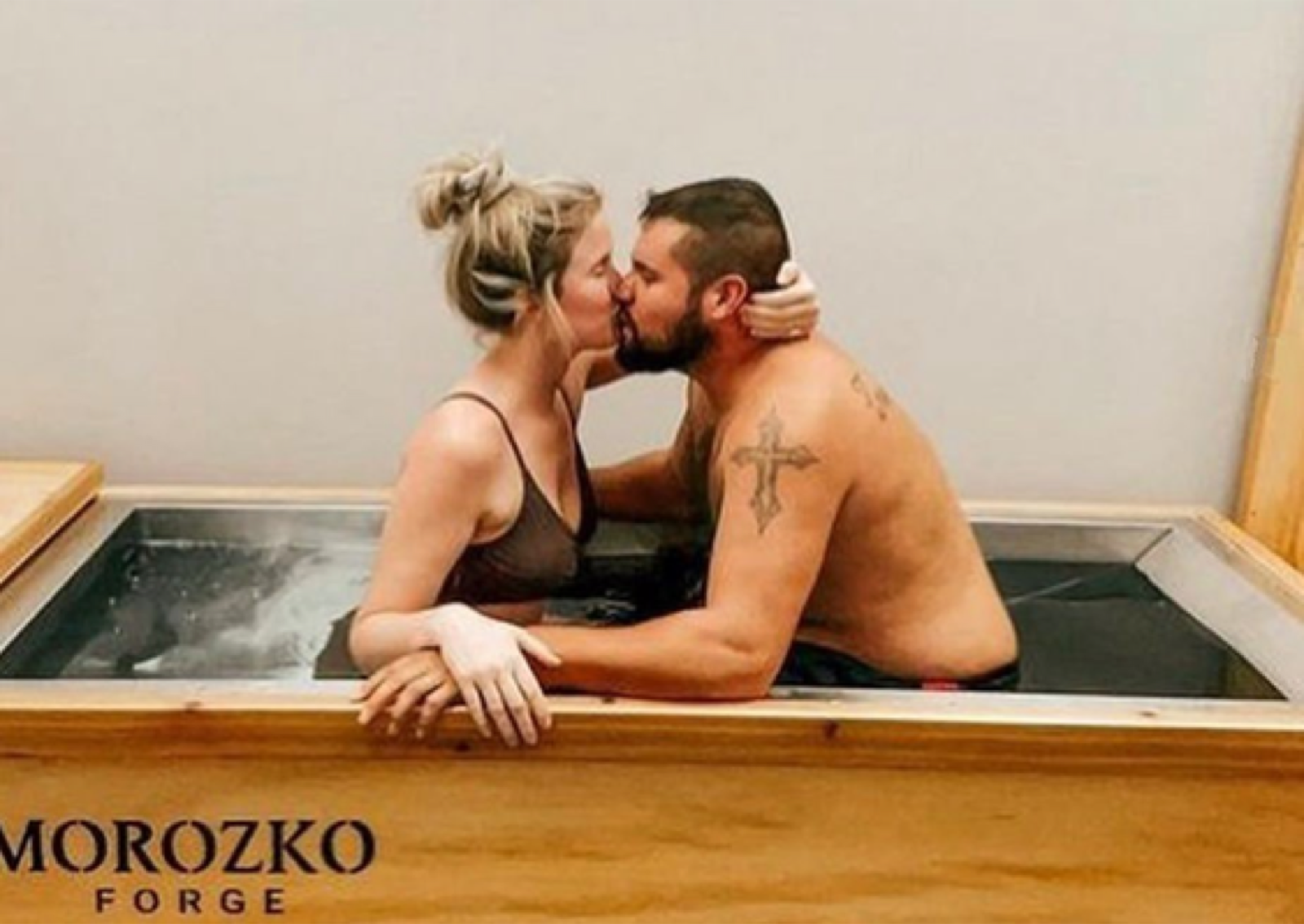
An ice bath can act like a love potion by activating all three brain systems of love, lust, romance, and attachment, according to Helen Fisher, PhD.
Summary
- Sexual attraction, romantic crushes, and love attachment are indicated by several different hormones and neurotransmitters, including testosterone, dopamine, norepinephrine,oxytocin,andvasopressin.AnicebathwithyourLovercan stimulate production of them all.
- Cold plunging with your partner might be good couples therapy, by creating a neurochemical love potion in both your brains.
- Follow this protocol to maximize the therapeutic benefits of your partner cold plunge:
1) touch one another while in the ice,
2) breath together, in synchrony,
3) gaze into one another’s eyes for two straight minutes, and
4) rewarm with exercise in the sun (if available).
What is love?
Three different brain systems of love
According to anthropologist Helen Fisher, PhD (e.g., Why We Love, Fisher 2004) there are at least three different brain systems identified with love:
- Lust — e.g., the sex drive. As human beings, we experience an involuntary, biological urge towards pro-creation that causes intrusive, indiscriminate thoughts and lustful fantasies. In both men and women, higher testosterone levels are associated with stronger sex drive.
- Romance — the obsessive, possessive, jealous feeling that focuses craving for emotional attachment with a single person. Romantic love is characterized by increased levels of dopamine and norepinephrine.
- Familial attachment— the profound sense of attachment and caring for the well-being of another. It is non-sexual, non-exclusive, and not obsessive. Familial love is what motivates use to care for our children, our brothers and sisters, or even our pets, and it is associated with increased oxytocin and vasopressin.
Brain chemistry of love
In her research, Fisher records brain scans and measures blood levels of neurotransmitters and hormones that correspond to these three different types of love. For example, she states that being “happily in love” stimulates activity deep in “the reptilian core of the brain” that manufactures dopamine and triggers wanting, craving, motivation, and reward systems (The Brain in Love, Fisher 2008).
More recent research confirms Fisher’s findings. Love creates a measurable chemical signature that suppresses serotonin, and raises dopamine, oxytocin, cortisol, vasopressin, and norepinephrine (Sayin & Schenk 2019).
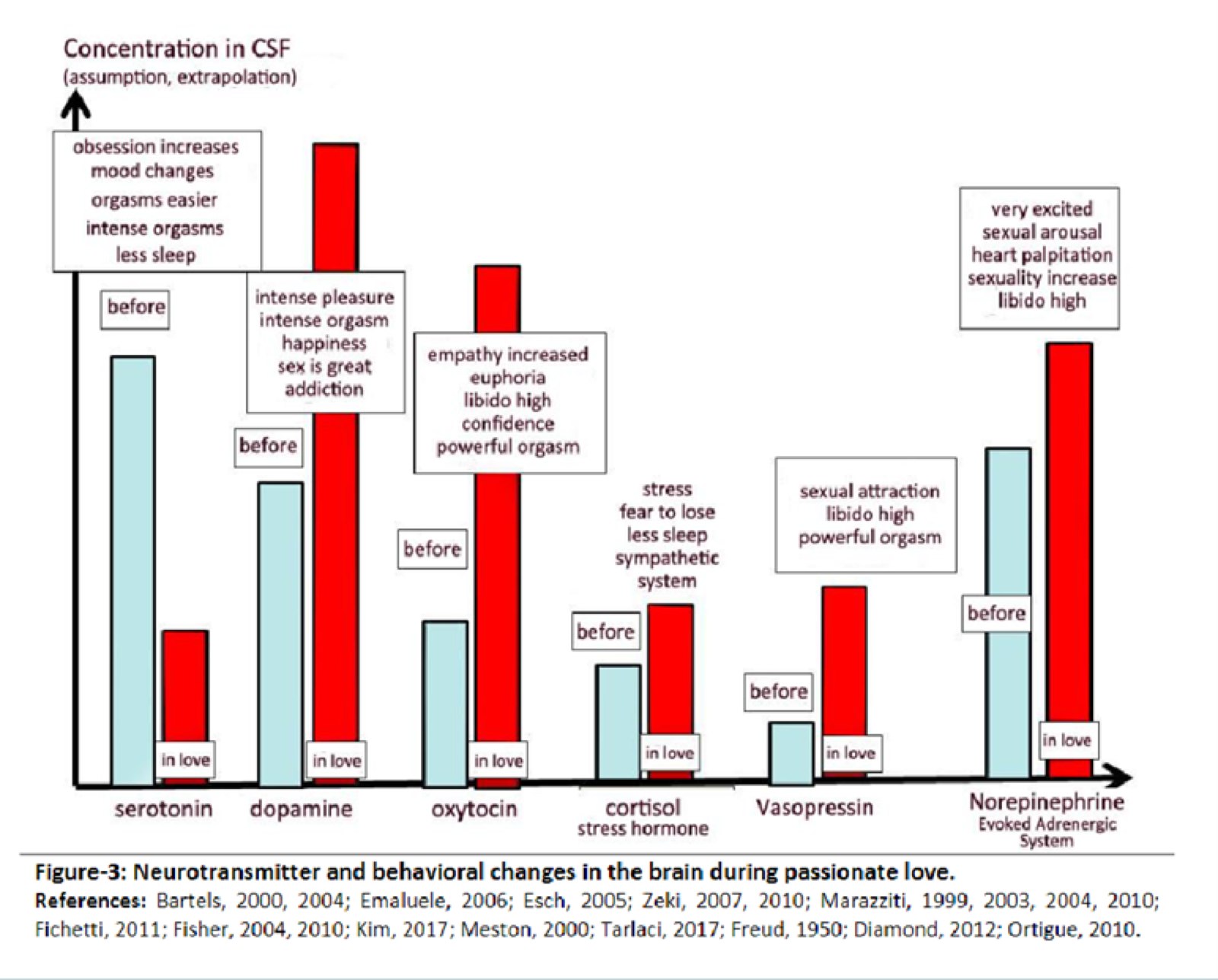
Feeling in love creates a measurable neurochemical signature (Sayin & Schenk 2019)
Although research can identify the characteristic neurochemical patterns of love, what has never been researched is whether the process also works in reverse. Could activating these same hormonal & neurotransmitter responses in some other way cause two people to fall in love, as a result of their shared brain chemistry?
No one has tested whether the neurochemical signature of love is exclusively the result of feeling in love, or whether stimulating the right neurochemistry can also cause feelings of love.
In my experience, it can.
Testosterone (lust)
In What happened to my testosterone when… I shared the experiences that raised my testosterone levels from a perfectly respectable 736 ng/dL in September 2017 to an astronomical 1180 ng/dL in August 2018. The key for me was to ice bath beforeexercise (rather than after), although I didn’t understand why until I read a study that compared the testosterone-boosting effects of exercise before and after cold exposure (Sakamoto et al. 1991).
The Japanese researchers discovered that an ice bath after exercise (e.g., for recovery) suppressed testosterone levels in the blood of their subjects. However, and ice bath followed by just 20 minutes on an exercise bike boosted blood serum testosterone levels. These findings have convinced several men to precool prior to their workout. For example, in Do Ice Baths Boost Testosterone? I documented several case studies of men and women who increased their total testosterone after adopting a regular practice of cold plunge therapy.
That’s super important, because when it comes to lust, or interest is not exclusively in men. It turns out that testosterone is also the most important sex hormone in women.
Typical blood serum concentrations of testosterone in women are 2-3 times greater than typical concentrations of estrogen.
Hormonal lab results confuse this fact because estrogen concentration is reported as picograms per milliliter (pg/mL), and testosterone is reported as nanograms per deciliter (ng/dL). To compare testosterone measurements in ng/dL to estrogen in pg/dL, you have to multiple the testosterone numbers by ten. Only then does it become obvious that, although
women have much less testosterone than men, healthy women still have several times greater concentrations of testosterone than estrogen.
As with men, testosterone levels in women typically decline with age — although they probably don’t have to. If my own experience is instructive, then it’s likely that youthful testosterone levels can be maintained well into middle age.
Nonetheless, women undergo a unique sexual transition in menopause. Because testosterone in women is produced by the ovaries, many women undergo a loss of testosterone when they discontinue ovulation. Despite that, testosterone is rarely prescribed for menopausal women except as a remedy for low libido. There are no US FDA-approved treatments for testosterone insufficiency in women, meaning for women who do seek testosterone therapy “clinicians have no choice but to prescribe T off-label, using T products approved for men but at a much lower dose appropriate for women” (Traish & Morgantaler 2022).
And what does testosterone do for women?
Just like in men, increased testosterone boosts sex drive in women (Davis & Tran 2001). Moreover, there is some evidence that deliberate cold exposure has the potential to stimulate increased testosterone in women, just as it can in men. An obscure Polish study on whole body cryotherapy reported:
After completing a series of whole body cryotherapy treatments, there was a significant improvement in libido. (Although) the change in this parameter should concern mainly men, in this research the change covered both sexes equally. – Rymaszewska et al. (2006)
Thus, it may be that the couple who ice baths together, and exercises together, will also experience a simultaneous boost in libido that kindles sexual desire between them. My experience, despite jokes about shrinkage, has been exactly this.
If there ever was a love potion, the ice bath might be it.
Dopamine & norepinephrine (romance)
In Can cold water swimming cure depression? I wrote about the massive increases in both dopamine and norepinephrine that accompany whole body cold water immersion. For example, Šrámek et al. (2000) measured increases in dopamine of 2-3 times pre-cold exposure levels — a surge so great that it may be impossible to remain in a bad mood after completing an ice bath. However, Fisher’s research in romantic, possessive love suggests that these chemicals are not just associated with a general feeling of euphoria, but that they focus obsessive romantic attention on a single individual.
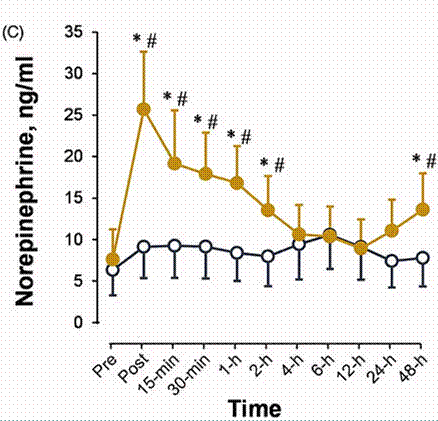
Levels of the love hormone norepinephrine spike immediately upon entering the ice bath, and stay elevated for hours afterwards (Eimonte et al. 2021)
A study of 10 healthy young adults at the early stages of heterosexual romantic relationships seems to confirm Fisher’s findings. Researchers compared brain activity in study subjects who viewed pictures of their love interest to activity when viewing a picture of an opposite sex person with whom they had no love interest. They discovered that dopaminergic sectors of the brain were more activated by romantic partners than by controls (Takahashi et al. 2015).
Oxytocin & vasopressin (attachment bonding)
Studies on administration of exogenous oxytocin and vasopressin have already demonstrated that these chemicals change orientations towards others. For example, oxytocin has a reputation for being the “cuddle hormone” because of its association with nurturing (Parmar & Malik 2017). Oxytocin and vasopressin together stimulate maternal, nurturing behaviors — but they also promote aggressive behaviors in mothers who perceive a threat to their young. In this way, we can say that oxytocin and vasopressin promote familial love in both the caring for and defense of those we love.
Unfortunately, measuring oxytocin and vasopressin in the body is problematic (Leng & Sabatier 2016), complicating interpretation of studies. Nevertheless, we can make some inferences about vasopressin by observing its actions on the body. In ‘Are you getting enough vasoconstriction?’ I wrote about how cold exposure causes contraction of the smooth muscle tissues that control blood flow to the extremities. These contractions are intended to reduce thermal losses, protect the vital organs in our torso, and it explains why our fingers and toes hurt so much in the ice bath.
We can infer from the physiological responses of the body to cold exposure — namely vasoconstriction and cold thermogenesis — that the neurochemicals vasopressin and oxytocin principally responsible for regulating these autonomic responses to cold exposure are likely activated by the ice bath.
Neurochemistry of the ice bath = love?
The remarkable finding of this review is that practicing deliberate cold exposure with your partner is likely to generate within you both the exact same neurochemical signature that characterizes lust, romance, and loving attachment, as summarized in Table 1 below:
| Love system | Neurotransmitter or hormone | Ice bath science | Relationship benefits |
| lust & desire | Testosterone | when followed by exercise, ice bath results in lasting increases | increased libido (sex drive) & sexual function in both men & women |
| romantic love | dopamine, norepinephrine | ice bath boosts levels by 3-4x multiple | feelings of euphoria, desire, & intense pleasure |
| attachment | oxytocin & vasopressin | implicated in vasoconstriction & cold thermogenesis | increased bonding & protective feelings |
The Love Potion Protocol
When you’re ready to try cold plunging with your partner, you don’t want to rely exclusively on the power of deliberate cold exposure to generate the neurochemistry of love — you want to ensure that those feelings are directed exclusively towards one another.
Cold plunging with a partner produces all the neurochemicals associated with love. The anxiety of the ice bath may cause couples to miss an opportunity to gain the full therapeutic effect of the ice bath. Tips to bring you closer while partner plunging include: holding hands, staring into one another’s eyes, and breathing together.
Couples cold therapy
It’s hard for me to imagine the ice bath approach to couples therapy going mainstream any time soon, given the level of vulnerability and surrender required to plunge into the freezing water. And it’s not likely that practicing an ice bath together will resolve power struggles, disputes over finances, or arguments about household chores. Nevertheless, a therapy that increases sexual attraction and function, boosts mood and romantic love, strengthens bonding and attachment, and creates a general feeling of euphoria in the company of your Lover might help melt away all the other, negative things that drove you apart in the first place.
About the Author
Thomas P Seager, PhD is an Associate Professor in the School of Sustainable Engineering at Arizona State University. Seager co-founded the Morozko Forge ice bath company and is an expert in the use of ice baths for building metabolic and psychological resilience.